
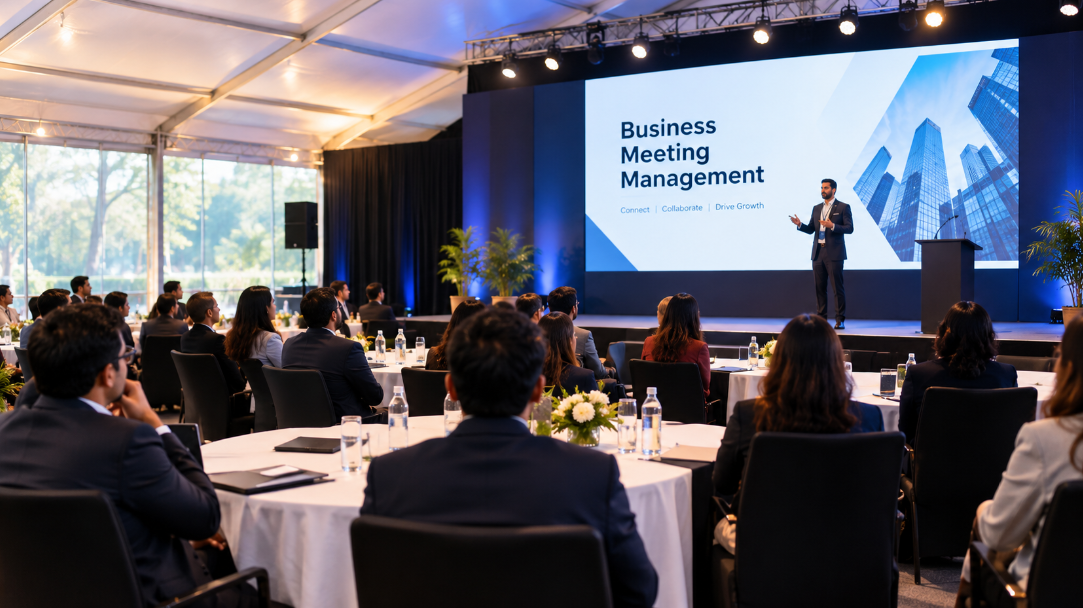
Business Meeting Management: Complete Guide to Planning Successful Business Meetings
A successful business meeting is more than gathering people in one room. It requires clear objectives, proper planning, the right venue, professional technology, effective communication and smooth coordination.
Business meeting management is the process of planning, organizing and executing business meetings to ensure that participants can communicate, collaborate and achieve the intended objectives efficiently.
Whether you are organizing a leadership meeting, client meeting, board meeting, dealer meet, strategy session or corporate conference, professional planning can make the experience more productive and organized.
What Is Business Meeting Management?
Business meeting management involves planning, coordinating and executing a business meeting from the initial concept to the final execution.
It can include:
Meeting planning and scheduling
Venue selection
Seating arrangements
Audio-visual setup
Presentation support
Corporate branding
Guest and participant management
Catering coordination
Technical support
Event logistics
On-site coordination
Post-meeting activities
The objective is to create a professional environment where participants can focus on discussions, presentations, decision-making and networking.
Why Is Business Meeting Management Important?
Poorly planned meetings can result in delays, communication problems, technical issues and reduced participant engagement.
Professional business meeting management helps companies create a structured and efficient meeting environment.
1. Saves Time
Proper planning ensures that the agenda, venue, participants, technology and meeting materials are ready before the meeting begins.
2. Creates a Professional Environment
The meeting environment represents the organization. A well-designed setup can create a professional experience for employees, clients, partners and stakeholders.
3. Improves Communication
A suitable seating arrangement, clear audio, presentation screens and appropriate lighting can make communication easier for participants.
4. Reduces Technical Problems
Professional meeting management includes checking microphones, screens, projectors, internet connectivity and other technical requirements before the meeting.
5. Improves Participant Experience
From registration and seating to refreshments and presentations, every detail contributes to the overall meeting experience.
Types of Business Meetings
Different meetings require different planning and infrastructure. A professional business meeting management company can customize the setup according to the purpose and number of participants.
Leadership and Management Meetings
Leadership meetings are designed for senior management teams to discuss business strategies, performance, operations and future plans.
These meetings generally require a comfortable and private environment with reliable presentation and communication facilities.
Client Meetings
Client meetings are an opportunity to present products, services, proposals or business solutions.
A professional setup can include:
Presentation screens
Comfortable seating
Corporate branding
Product displays
Refreshments
Audio-visual support
Board Meetings
Board meetings require a professional and organized environment because they often involve important business discussions and decision-making.
The setup may include a conference table, executive seating, presentation screens, microphones, video conferencing and supporting technology.
Dealer and Distributor Meetings
Dealer meets and distributor meetings help companies communicate with their business partners, introduce products and discuss business performance.
These meetings can be organized as small gatherings or larger corporate events with presentations, product demonstrations and networking sessions.
Sales Meetings
Sales meetings help teams review targets, discuss performance, introduce strategies and align sales teams.
A professional presentation setup and comfortable seating can improve the meeting experience.
Strategy Meetings
Strategy meetings bring decision-makers together to discuss business objectives, market opportunities, challenges and future plans.
The meeting environment should support focused discussions and collaboration.
Conferences and Corporate Gatherings
Large business meetings can take the form of conferences, seminars, annual meetings or corporate gatherings.
These events require additional planning for stage production, seating, registration, branding, sound, lighting and audio-visual technology.
How to Plan a Successful Business Meeting
Effective business meeting management starts well before the actual meeting date.
Step 1: Define the Meeting Objective
The first step is to determine why the meeting is being organized.
Ask:
What is the purpose of the meeting?
Who needs to attend?
What decisions need to be made?
What information needs to be presented?
What should participants achieve by the end?
A clear objective makes it easier to create an effective agenda.
Step 2: Finalize the Participants
Prepare a list of required participants and confirm their availability.
Depending on the meeting, participants may include:
Company directors
Senior management
Employees
Clients
Business partners
Dealers
Distributors
Investors
Industry professionals
Step 3: Choose the Right Venue
The venue should match the size and purpose of the meeting.
Consider:
Location
Accessibility
Seating capacity
Parking
Privacy
Internet connectivity
Power supply
Audio-visual facilities
Catering
Branding opportunities
For smaller meetings, a boardroom or conference room may be suitable. Larger business meetings may require hotels, convention centres, auditoriums or specially designed event spaces.
Step 4: Create a Meeting Agenda
A well-structured agenda keeps the meeting focused.
An agenda can include:
Welcome and introduction
Meeting objectives
Key presentations
Discussion points
Questions and answers
Decision-making
Action items
Closing remarks
Share the agenda with participants in advance whenever possible.
Step 5: Plan the Seating Arrangement
The seating arrangement should match the meeting format.
Common options include:
Boardroom setup
U-shaped setup
Classroom setup
Theatre setup
Round-table setup
Cluster seating
The right configuration depends on whether the meeting is focused on presentations, discussions, training, networking or collaboration.
Step 6: Arrange Audio-Visual Equipment
Technology is an important part of modern business meeting management.
Depending on the meeting, you may require:
LED screens
Projectors
Presentation screens
Microphones
Speakers
Video conferencing systems
Laptops
Clickers
Stage lighting
Internet connectivity
All equipment should be tested before participants arrive.
Step 7: Add Corporate Branding
Corporate branding can make a meeting look more professional and consistent with the company’s identity.
Branding options include:
Entrance branding
Stage backdrop
Logo displays
LED screen graphics
Directional signage
Registration counters
Branded presentation screens
Photo walls
Branding is especially useful for client meetings, dealer meets, conferences and product presentations.
Step 8: Coordinate Catering and Hospitality
Depending on the duration of the meeting, participants may require:
Welcome beverages
Tea and coffee
Snacks
Lunch
Dinner
Water stations
Hospitality should be planned according to the meeting schedule so that it does not interrupt important discussions.
Step 9: Conduct a Technical Rehearsal
A technical rehearsal can identify potential problems before the meeting starts.
Check:
Microphones
Speakers
Presentation files
LED screens
Projectors
Lighting
Internet connection
Video conferencing
Power backup
This step is particularly important for high-profile business meetings and large corporate events.
Step 10: Manage the Meeting On-Site
On the day of the meeting, an experienced event team can coordinate venue setup, participant arrival, technical requirements, presentations, hospitality and schedule management.
A dedicated coordinator can also respond quickly if there are changes or unexpected requirements.
Business Meeting Management Checklist
Before the meeting, use this checklist:
Planning
Define the objective
Finalize the date and time
Confirm participants
Prepare the agenda
Select the venue
Allocate the budget
Venue
Confirm seating capacity
Check accessibility
Check parking
Inspect meeting room
Confirm power supply
Check internet connectivity
Technology
Test microphones
Test speakers
Check presentation screens
Test LED/projector
Check video conferencing
Keep backup equipment where required
Branding
Prepare stage backdrop
Confirm logo placement
Design presentation graphics
Prepare signage
Arrange registration branding
Hospitality
Confirm refreshments
Arrange lunch or dinner
Prepare guest registration
Confirm water stations
On-Site
Complete setup before guest arrival
Conduct technical rehearsal
Brief the event team
Confirm agenda
Coordinate speakers
Monitor the event throughout
How Much Does Business Meeting Management Cost?
The cost of business meeting management depends on the requirements of the meeting.
Factors that can influence the overall cost include:
Number of participants
Venue
Meeting duration
Audio-visual equipment
Stage requirements
Branding
Furniture
Catering
Technical manpower
Transportation
Event infrastructure
Production requirements
A small board meeting and a 500-person corporate conference will naturally have very different requirements.
For this reason, professional event companies generally provide customized proposals based on the meeting format, participant count and services required.
Why Hire a Professional Business Meeting Management Company?
Managing a business meeting internally can become challenging when several vendors and technical requirements are involved.
A professional event management company can coordinate multiple elements through one team.
Centralized Coordination
Instead of managing separate vendors for venue setup, production, branding and technical services, a professional event team can coordinate the different requirements.
Professional Setup
Experienced teams understand seating layouts, event flow, stage design, technical production and participant experience.
Better Time Management
Professional planning helps ensure that setup, rehearsals and event activities are completed according to schedule.
Technical Support
An on-site technical team can monitor sound, screens, presentations and other equipment during the meeting.
Customized Experience
Every company has different objectives. Meeting setups can be customized according to the brand, audience, venue and event format.
Business Meeting Management for Different Company Sizes
Small Businesses
Small businesses may require board meetings, client presentations, strategy sessions and team meetings.
The focus is generally on comfortable seating, professional presentation facilities and efficient coordination.
Medium-Sized Businesses
Medium-sized organizations may conduct larger sales meetings, dealer meets, training sessions and corporate conferences.
These events may require additional audio-visual equipment, branding and hospitality.
Large Enterprises
Large organizations often conduct multi-day conferences, annual meetings, product launches, dealer conferences and large corporate gatherings.
These events require detailed planning, production management, infrastructure, branding and on-site execution.
Business Meeting Management and Event Infrastructure
For large corporate meetings, infrastructure can become an important part of the event.
Depending on the location and event requirements, infrastructure may include:
German Hanger Structures
Pagoda Tents
Flooring
Stage platforms
Lighting
Sound systems
Branding
Partitions
Seating
Outdoor business meetings may require additional planning for weather, flooring, power, guest movement and temporary structures.
This is why companies planning large business meetings should consider both meeting management and event infrastructure during the planning stage.
Why Airoshelt for Business Meeting Management?
Airoshelt provides event management and event infrastructure solutions for corporate gatherings, conferences, meetings, exhibitions, product launches and other business events.
The company can support different elements of an event, including event planning, venue setup, stage production, lighting, sound, branding and event infrastructure.
For larger meetings and corporate gatherings, Airoshelt also provides infrastructure solutions such as German Hanger Structures, Pagoda Tents, flooring, lighting, branding and other event requirements.
By combining event management and event infrastructure, companies can coordinate multiple event requirements through a single event partner.
How to Make Business Meetings More Effective
Professional meeting management is not only about creating an attractive setup. The meeting itself should be structured around clear communication and measurable outcomes.
Here are some practical tips:
Keep the Agenda Clear
Participants should know what will be discussed and what outcomes are expected.
Start on Time
Starting and finishing according to schedule shows respect for participants’ time.
Use Professional Presentation Technology
Clear visuals and reliable audio-visual equipment can make presentations easier to understand.
Encourage Participation
Depending on the meeting format, allow time for questions, discussions and feedback.
Assign Responsibilities
Identify who will present, who will coordinate the meeting and who will document action items.
Document Decisions
Important decisions and responsibilities should be recorded so participants know what happens next.
Follow Up After the Meeting
A professional follow-up can include meeting minutes, decisions, deadlines and assigned responsibilities.
Frequently Asked Questions About Business Meeting Management
What is business meeting management?
Business meeting management is the process of planning, organizing and executing business meetings, including venue selection, seating, technology, branding, hospitality, logistics and on-site coordination.
What does a business meeting management company do?
A business meeting management company can coordinate venue setup, seating, audio-visual equipment, branding, hospitality, technical support, event logistics and on-site management.
What types of business meetings can be managed?
Business meeting management can cover board meetings, client meetings, leadership meetings, strategy sessions, sales meetings, dealer meets, conferences, seminars and corporate gatherings.
How do I plan a successful business meeting?
Start by defining the meeting objective, identifying participants, selecting the venue, creating an agenda, planning seating and technology, arranging hospitality and conducting a technical rehearsal before the meeting.
How much does business meeting management cost?
There is no fixed cost. Pricing depends on the number of participants, venue, duration, audio-visual requirements, branding, catering, infrastructure and other services.
What equipment is required for a business meeting?
Depending on the meeting format, equipment may include microphones, speakers, LED screens, projectors, laptops, presentation clickers, lighting, video conferencing equipment and internet connectivity.
Can business meetings be organized outdoors?
Yes. Outdoor business meetings can be organized with suitable event infrastructure such as temporary structures, flooring, lighting, seating, branding and technical facilities. Weather and site conditions should be evaluated during planning.
Why should a company hire a professional meeting management company?
A professional company can coordinate multiple requirements such as venue setup, production, branding, logistics, hospitality and technical support, reducing the coordination burden on the company’s internal team.
Conclusion
Effective business meeting management combines planning, communication, technology, hospitality and professional execution.
From a small leadership meeting to a large corporate conference, every meeting requires careful attention to its objective, participants, venue, agenda, technology and overall experience.
Choosing the right event management partner can help businesses coordinate these elements efficiently and create a professional environment for meaningful discussions, presentations and business decisions.
Planning a business meeting in Pune?
Airoshelt can help you plan and execute professional corporate meetings, conferences and business events with integrated event management and event infrastructure solutions.